How a Token-First Language Axis Is Reshaping Multimodal AI
- Why We Need Foundational Multimodal Models
- Unifying Modalities Through Discrete Tokens
- Any-to-Any Generation: Tasks Become Queries
- Fine-Grained Control & Steerability
- Language Co-Training & Improved Understanding
- Beyond Generation: Retrieval and Evaluation
- Authors and Official Attribution
- Conclusion: Foundations Built, But the Frontier Remains
- References
Why We Need Foundational Multimodal Models
Today’s AI landscape is fractured. Vision models, language models, and geometric/semantic prediction pipelines each solve narrow tasks. Yet real-world systems—from robotics to complex retrieval agents—require joint reasoning across perception, structure, and semantics.
Current multimodal systems rely on:
- task-specific heads,
- bespoke pipelines,
- engineering-heavy loss balancing.
This approach does not scale. It fragments learning into silos instead of enabling true compositional understanding and control.
We need what language models gave us for text: a foundation model whose representations can be queried, composed, and extended without redesigning the architecture for every new task or modality.
This is exactly the paradigm shift that 4M: Massively Multimodal Masked Modeling and its scaled variant 4M-21: An Any-to-Any Vision Model for Tens of Tasks and Modalities introduce.
“A framework for training any-to-any multimodal foundation models. Scalable. Open-sourced. Across tens of modalities and tasks.” — 4M official page
Unifying Modalities Through Discrete Tokens
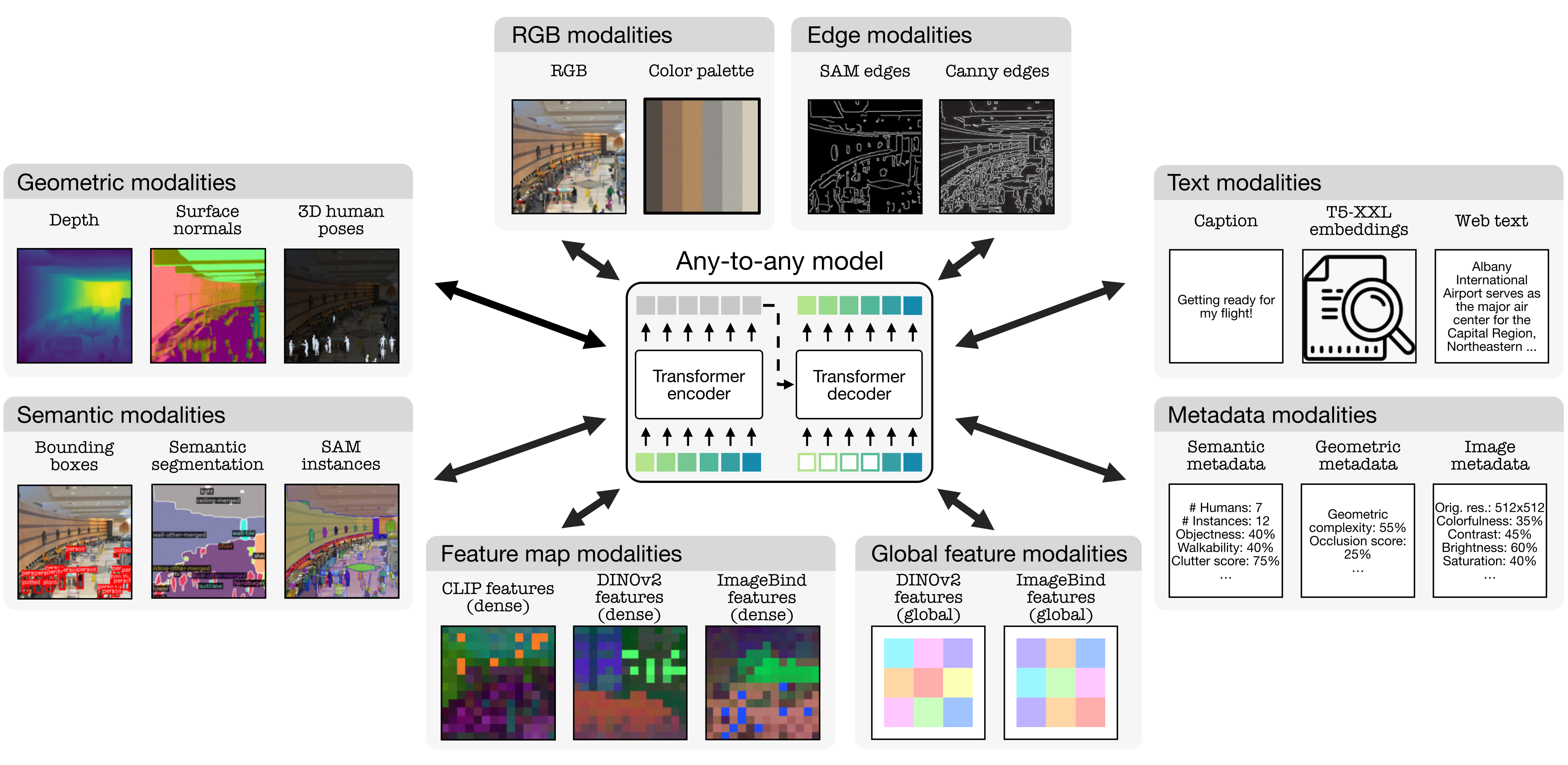
4M trains a single model to predict any modality from any subset of others using discrete tokenization. (Source: 4M project page)
At the core of 4M and 4M-21 is discrete tokenization:
- Images, depth maps, geometry, semantic maps, captions, and feature maps all become sequences of discrete tokens.
- A single transformer encoder-decoder predicts masked tokens from visible ones.
- There are no task-specific heads or bespoke objectives.
The official site summarizes this succinctly:
“By tokenizing modalities into sequences of discrete tokens, we can train a single unified Transformer encoder-decoder on a diverse set of modalities.” (Source: 4M project page)
This token-centric representation is the unifying abstraction that lets one model handle diverse data types without architectural surgery.
Any-to-Any Generation: Tasks Become Queries
4M can generate any modality from any conditioning set in a self-consistent chained manner. (Source: 4M project page)
One of the most striking capabilities shown on the official page is any-to-any generation. Instead of solving fixed tasks like “caption this image” or “predict depth from color”, 4M generates all modalities from whichever subset you choose.
The generation works by:
- Predicting missing tokens for one modality.
- Feeding fully generated modalities back into the model.
- Repeating until all target modalities are generated.
This yields self-consistent, multimodal predictions without loss balancing or head selection (see 4M project page).
Fine-Grained Control & Steerability
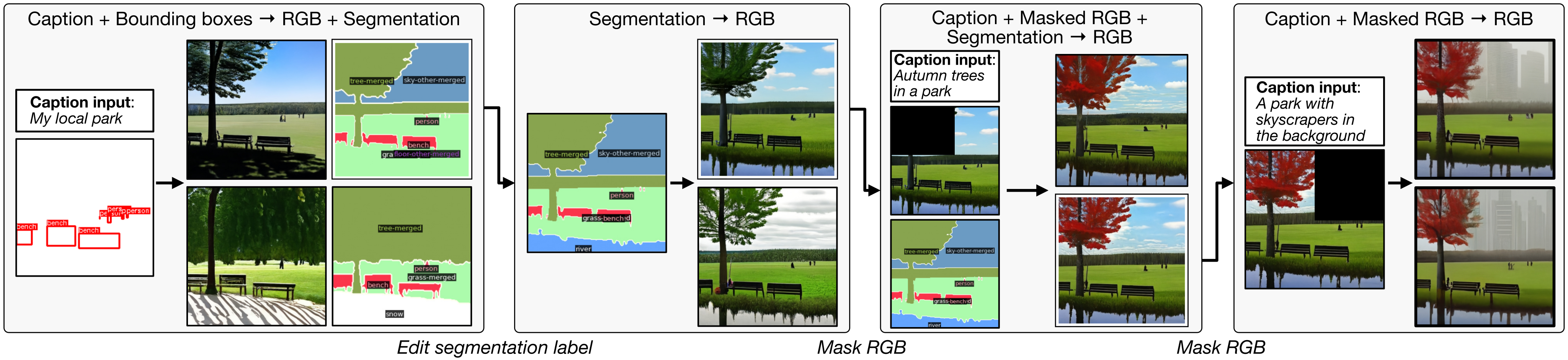
4M supports multimodal editing and fine-grained control, such as bounding box–guided RGB generation. (Source: 4M project page)
Because 4M represents all data in token form, it supports:
- partial conditioning (e.g., captions + bounding boxes),
- semantic and geometric guidance,
- compositional weighting of conditions.
The official visuals demonstrate how changing a bounding box input can reorganize the RGB output—semantic edits become natural rather than hacky (4M project page).
Language Co-Training & Improved Understanding
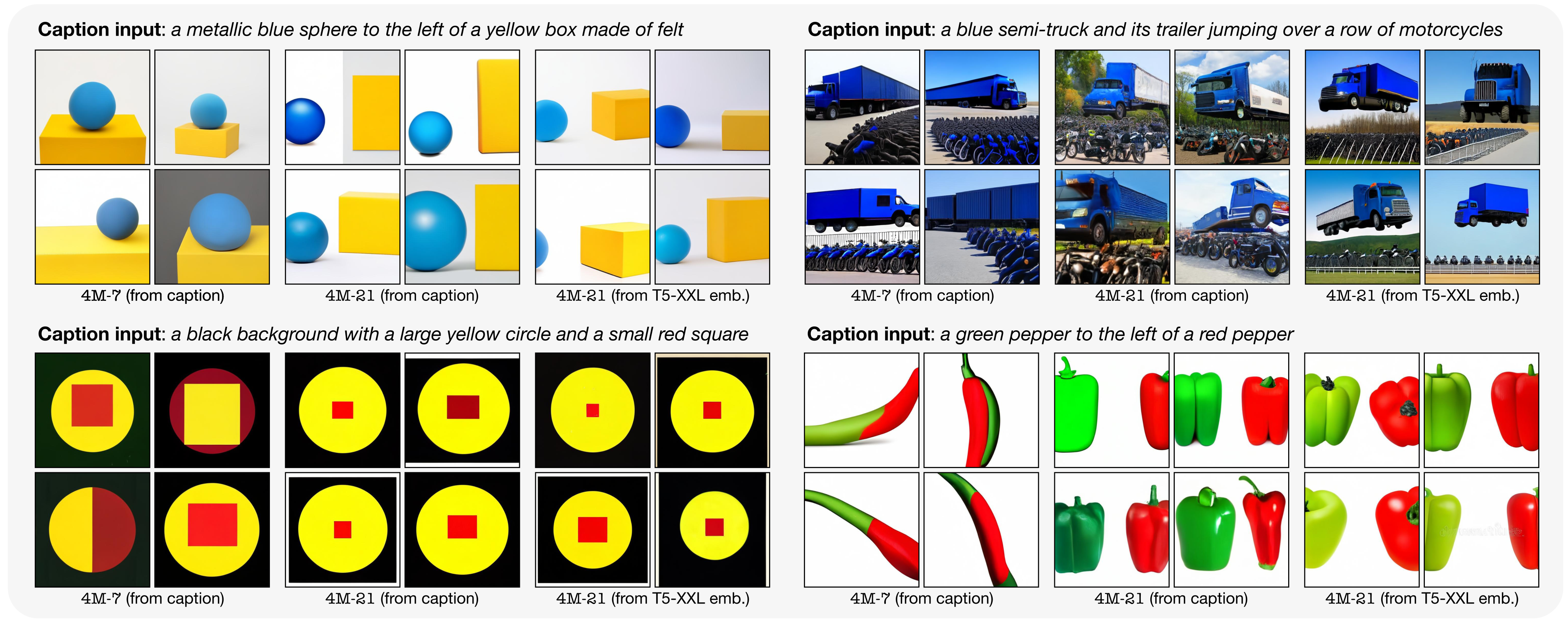
4M-21 models co-trained with text corpora show stronger text understanding than smaller multimodal variants. (Source: 4M project page)
4M-21 extends 4M by co-training on large text corpora and incorporating language as a structural modality rather than a side condition. The official site notes:
“4M models trained on a larger variety of modalities and co-trained on a text corpus exhibit a higher degree of text understanding.” (Source: 4M project page)
This positions language not just as a human interface, but as a semantic scaffold the model uses internally to organize multimodal representations.
Beyond Generation: Retrieval and Evaluation
The official project page also highlights:
- Multimodal retrieval by predicting global embeddings from any modality (4M project page).
- Out-of-the-box evaluations showing 4M-21’s performance often matches or surpasses specialist baselines and multimodal competitors like Unified-IO (4M project page).
Authors and Official Attribution
This work is the result of collaboration between EPFL and Apple researchers:
David Mizrahi, Roman Bachmann, Oğuzhan Fatih Kar, Teresa Yeo, Mingfei Gao, Afshin Dehghan, Amir Zamir… and colleagues — 4M & 4M-21 teams.
Both papers are available from the official 4M project site:
- 4M: Massively Multimodal Masked Modeling (NeurIPS 2023) — Mizrahi et al., 2023
- 4M-21: An Any-to-Any Vision Model for Tens of Tasks and Modalities (NeurIPS 2024) — Bachmann et al., 2024
Conclusion: Foundations Built, But the Frontier Remains
4M and 4M‑21 mark a turning point in multimodal AI. They show that:
- Unified token spaces work across dozens of modalities
- Language can serve as a structural interface, not just a conditioning signal
- Tasks can emerge from conditioning rather than engineered heads
- Models can scale without performance collapse, even as modalities triple
Yet as impressive as these results are, the frontier of true multimodal intelligence is still wide open.
What 4M‑21 Does Not Do—Yet
The project is not a reasoning-first system. It cannot plan, chain steps explicitly, or act autonomously:
- Emergent reasoning is limited: There’s no explicit chain-of-thought or planning; constraint satisfaction occurs implicitly across tokens.
- Tokenization bottlenecks exist: Discretization is lossy, which limits fidelity for complex modalities.
- Dataset alignment is partial: Some modalities and datasets are only loosely coordinated, leaving room for inconsistencies in training.
In other words, 4M‑21 is a foundation backbone, not an agent or cognitive system. It lays the groundwork, but the “thinking” part—planning, instruction-following, and compositional reasoning—is still to come.
The Road Ahead: Directions to Watch
The official project and research notes point to several promising avenues:
-
Better tokenization schemes
Adaptive, higher-fidelity tokenizers could reduce reconstruction loss and improve fine-grained multimodal generation. -
Explicit reasoning objectives
Integrating constraint-based or reasoning-centered training could turn implicit consistency into explicit reasoning capabilities. -
Instruction tuning over token sequences
Just like LLMs benefit from instruction fine-tuning, multimodal backbones could learn to follow structured multimodal instructions across domains. -
Integration with agentic architectures
Combining unified token spaces with LLM-style planners, memory modules, or embodied agents could finally unlock reasoning and agency in multimodal systems.
In short, 4M‑21 has built the scalable, unified foundation, and the next frontier is layering reasoning, instruction-following, and agency on top.
The lesson for the field is clear: multimodal AI has crossed the threshold of scalability and unification—but intelligence still has a way to go. The foundation is there; now comes the building.
References
- 4M official project page, Massively Multimodal Masked Modeling, EPFL / Apple Research.
- Bachmann, R., et al. (2024). 4M-21: An Any-to-Any Vision Model for Tens of Tasks and Modalities. Advances in Neural Information Processing Systems (NeurIPS 2024). Available at 4m.epfl.ch.
- Mizrahi, D., et al. (2023). 4M: Massively Multimodal Masked Modeling. Advances in Neural Information Processing Systems (NeurIPS 2023). Available at 4m.epfl.ch.
If you found this useful, please cite this as:
Rossetti, Simone (Jan 2026). How a Token-First Language Axis Is Reshaping Multimodal AI. https://rossettisimone.github.io.
or as a BibTeX entry:
@article{rossetti2026how-a-token-first-language-axis-is-reshaping-multimodal-ai,
  title   = {How a Token-First Language Axis Is Reshaping Multimodal AI},
  author  = {Rossetti, Simone},
  year    = {2026},
  month   = {Jan},
  url     = {https://rossettisimone.github.io/blog/2026/how-a-token-first-language/}
}
Enjoy Reading This Article?
Here are some more articles you might like to read next:
Subscribe to be notified of future articles: